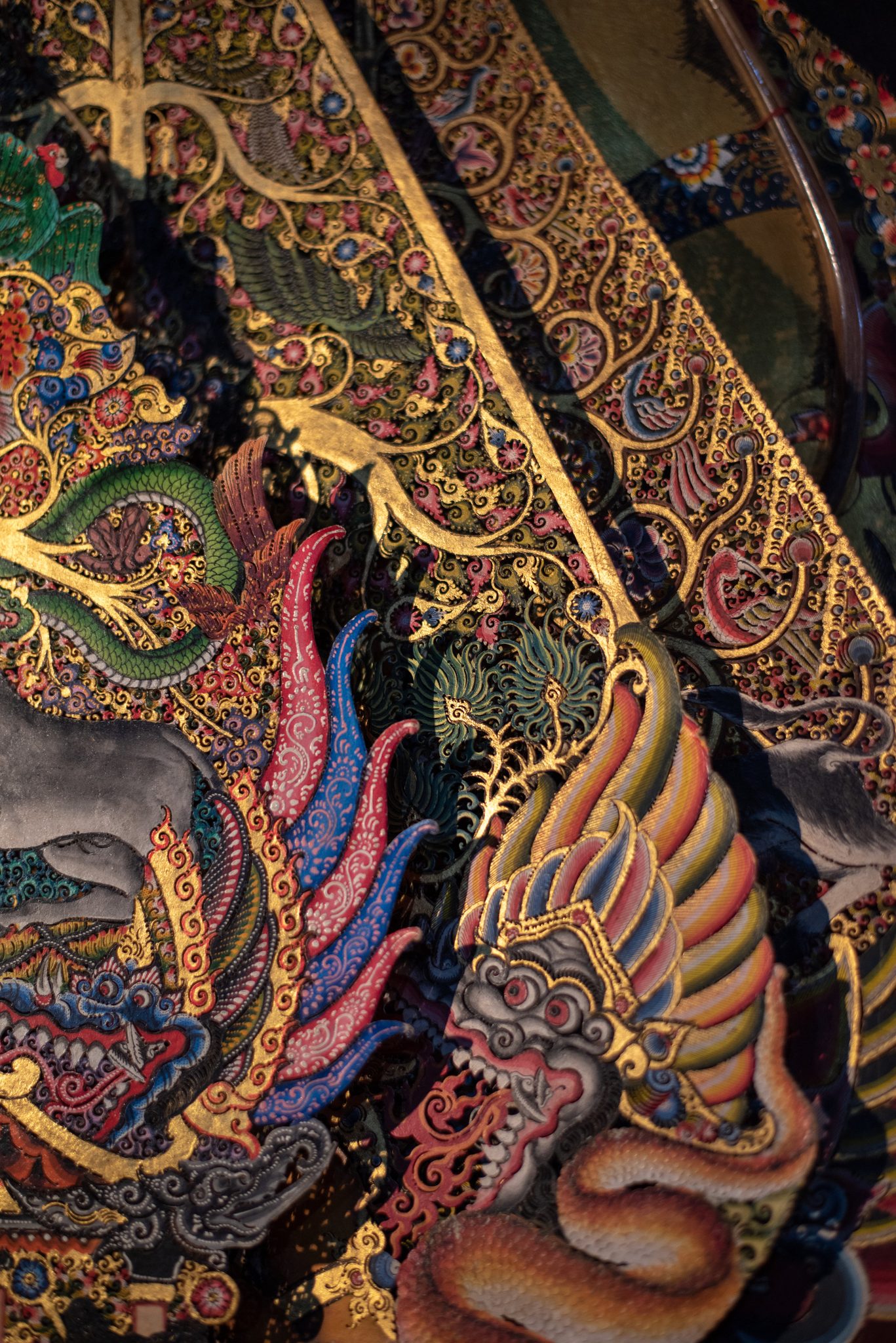
Before there were words, before symbols gave rise to written language, there were stories. Tales that regaled the sacred knowledge that begot religions. Legends of our origins, of battles between gods and demons, of kings and heroes who upheld virtue against the forces of evil. These most ancient of stories, retold time and time again have transcended human history. And while most have been forgotten, there are still those who seek to preserve them.
Ki Seno Nugroho sits backstage with his orchestra before they begin their performance.
Ki Seno Nugroho, a shadow puppeteer known as a dalang, reaches beside him into an immense wooden chest called the cempala. He pulls out an intricately designed leather puppet and stabs the pointed handle into the banana tree trunk mounted before him. The character is Arjuna, the beloved warrior king from the Mahabharata. Up goes his thin leather arms in reverence to the heavenly realm. The dalang speaks in ancient Javanese as the shadows begin to tell the story…
Recently crafted gamelan gong perched on a bench
...Of the Wayang Kulit.
Ki Seno breathes smoke moments before the performance begins. One of the most widely known dalangs in Indonesia, he drew crowds by the thousands and paired the soul of a mystic with the mirth of a performer.Ki Seno and his singers begin their all night performance
Gamelan player focusesKi Seno enjoys a quiet moment before another performance. He performed his night-long Wayang Kulit stories tirelessly, five, six, even seven times a week.
The Wayang Kulit shadow puppets tell a story
Shadow puppets stacked in the cempala (large wooden chest)Dhidot plays the gamelan while his wife relaxes in the back ground
Gong being forged in fire
Village gathers to watch the Wayang Kulit performanceGamelan manufacturers preparing orders
Leather hides (usually cow) that will eventually become shadow puppets
An array of shadow puppets strategically laid outKi Seno and his singers
Dhidot, a master shadow puppet maker, meticulously hammers designs into a new puppet. His knowledge has been passed down for generations, and each puppet takes weeks to months to make.
A gong in the fire. Sparks rise in their primordial dance between fire and sky, the red-hot bronze pounded into shape by sinew and bone.Dhidot paints a new puppet. Like his father and his father's father before him, he carries on a legacy of craftsmen.
Performers relax before the show begins
Ki Seno enjoys some banter with his companionsGamelan keys being forged
Ki Seno begins his opening chant
More camaraderie among the performersKi Seno performs, moving the puppets as he narrates and tapping his kepyak with his toe to keep the gamelan in time with the scene.
Crowd in Bantul enjoys the performance
Shadow puppet characters. The oldest Wayang Purwa stories predate modern religions. Later they took in the Mahabharata and the Ramayana, and later still carried Islamic messages told with Hindu characters.Father and child enjoy the local Wayang Kulit performance
The chicken and fruit represent Sajen, a gift offering to the spirits
The fire belches embers into the dust-laden air as gamelan makers in Yogyakarta heat and pound the molten bronze. They will spend the entire day making one gong.Large gamelan gong is carefully polished
A team of blacksmiths hammers out the shape of the gong. Back into the fire it goes, dozens of times, until the shape is perfect.
Gamelan maker prepares the zinc and iron ore for meltingSinger applies make-up before performance
A masked worker tends the forge as sparks leap into the dark of the workshop.
Sparks drift like fireflies past the blacksmiths waiting on their bench.The metal heats in its crucible, flames licking purple at the rim.
Gamelan maker blows on molten keys
Full gamelan orchestra made to order, usually taking 1-2 months to completeTwo men pray before their performance in Sleman.
Gamelan maker works machine to polish smaller gongs
The forge erupts in a column of sparks while the blacksmiths watch from the bench. There was something profound in these moments, when flame begot music.The workshop at rest, tools and a kettle waiting on the bench for the next pour.
Blacksmith tools
Ki Seno moves his kris (ceremonial dagger) to his back, marking the beginning of the Wayang Kulit performanceEnthusiasts gather behind the screen to watch the traditional way, where the shadows come to life. Only in the mid-nineties did the audience move to the side of the dalang and the gamelan.
Singers get pampered before their performance.
Members of the gamelan orchestra converse and eat before the showSweets for children are placed in front of a door during the performance