Ki Seno Nugroho was one of the most widely known dalangs in Indonesia, drawing crowds by the thousands. It takes many years to become a dalang, and even those who succeed often escape notice. But Ki Seno recaptured the soul of this ancient art in a way that breathed new life into stories older than most civilizations. He performed his night-long stories five, six, even seven times a week with his family of singers and musicians, pairing the soul of a mystic with the mirth of a performer. In memory of the legendary Ki Seno Nugroho. I will never forget his kindness during those long nights in Jogja.
Between the mats and the empty glasses, a man checks his phone against the pillar.Singers get pampered before their performance.
Men in batik settle onto the mats in the pavilion. The screen and its puppets are already waiting.A man lifts his phone to photograph the women seated along the pavilion wall.
A singer in white lace checks her makeup in her phone's camera.
A man in batik leans against a red pillar with his phone, red and white bunting strung overhead.Ki Seno raises a puppet to the lamp while five singers in pink kneel in a row beside him.
One singer fixes her earring, another checks her face, both in white lace.
Ki Seno Nugroho sits backstage with his orchestra before they begin their performance.Ki Seno Nugroho lifts a puppet from beside the screen, beneath a banner bearing his name.
Ki Seno and his singers begin their all night performance
Village gathers to watch the Wayang Kulit performanceMore camaraderie among the performers
Singers and musicians wait out the hour on carved wooden chairs.
One singer paints the other's nails, both already dressed in lace for the show.Two men in batik and headcloths share a laugh against the plaster wall.
Through an open door, the performers wait in the lamplight. Outside, the night stays dark.
Ki Seno moves his kris (ceremonial dagger) to his back, marking the beginning of the Wayang Kulit performanceThe laughter comes easy while the polish dries.
Smoke drifts through the room as the performers laugh and wait.
Ki Seno and his singersA singer takes a selfie in front of the rows of puppets.
The gamelan orchestra settles in under the tent, the village crowd filling the dark beyond.
The singers kneel in a row of white lace, and at the end of the line an elder in a headcloth can't hide his smile.A gamelan player looks up from his instrument, waiting for his cue.
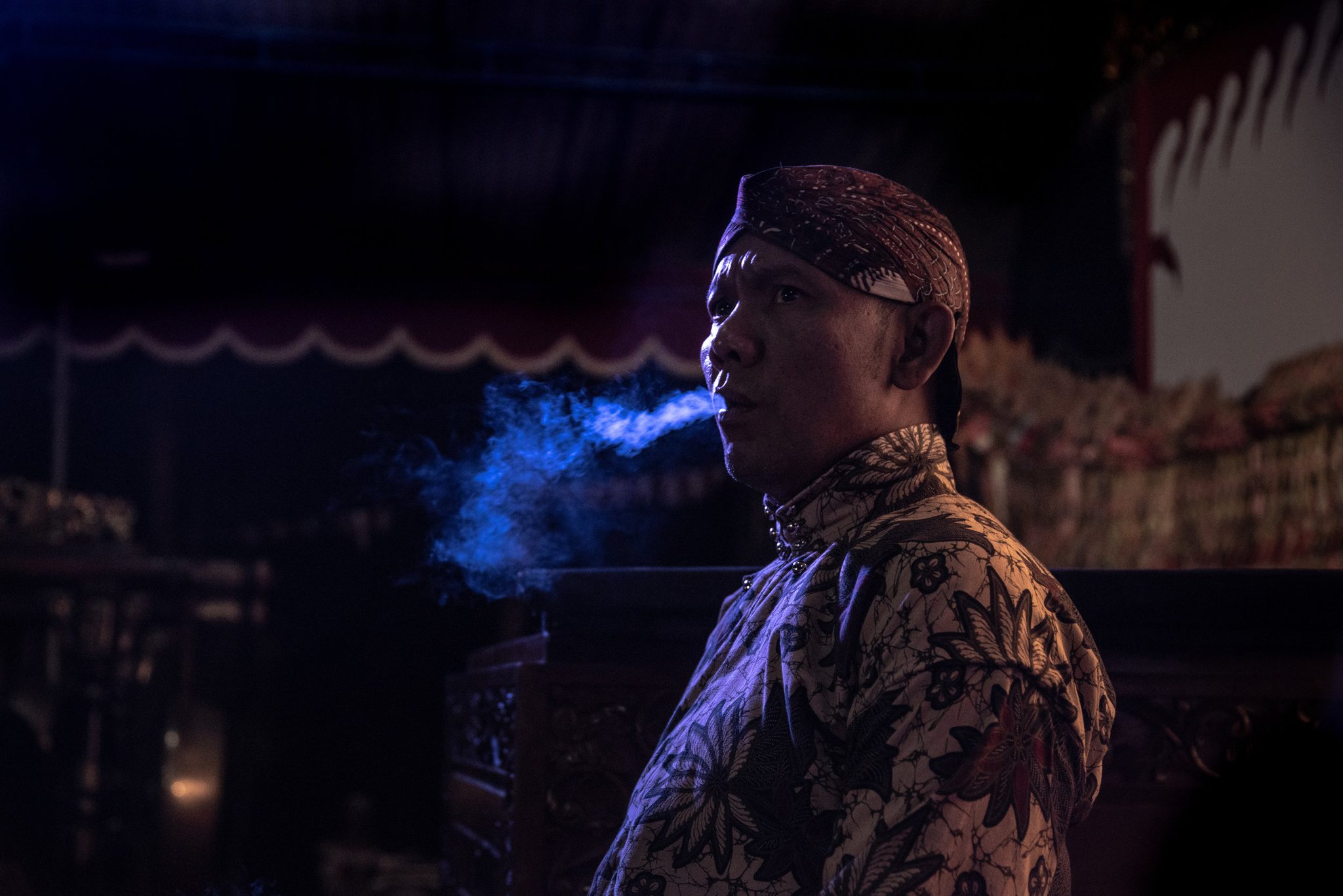
A performer exhales a cloud of smoke into the blue stage light.
A man in a batik headcloth leans over the wooden chest, the puppets standing at his back.Ki Seno lifts two puppets to the screen, their shadows joining the painted ones behind.
Ki Seno performs, moving the puppets as he narrates and tapping his kepyak with his toe to keep the gamelan in time with the scene.
Six singers wait their turn, every one of them on her phone.A musician draws his bow across the rebab, the two-stringed fiddle of the gamelan.
A player waits behind his row of bronze kettle gongs.
In the dark beside the stage, the dalang's bare foot taps the kepyak, the hanging metal plates that cue the gamelan.The sound man rides the faders while the village crowds in to watch.
Enthusiasts gather behind the screen to watch the traditional way, where the shadows come to life. Only in the mid-nineties did the audience move to the side of the dalang and the gamelan.
A singer rises to her feet and sings into the night, the gongs glinting in the dark.Crowd in Bantul enjoys the performance
A grinning musician leans in as the singers pass a phone down the line.
The great gong hangs in the dark, waiting for the one note that belongs to it.The singers dissolve into laughter, hands over their mouths.