In March 2020 I went to the Yucatán to work on a story about the Mayan connection to nature. Under a full moon, a few of us sat beneath bare branches in Don Edgar's garden in Acanceh, learning the sacred symmetries of the Maya. In the village of Ek Balam, the Black Jaguar, farmers like Don Simo grow milpas by ancient methods, and Sembrando Vida pays villagers to plant trees. The story was cut short by COVID, when borders began closing and forced an early return. I share it in service of all that has been lost, in the hope that something can be saved from the ruins. With thanks to my partner on this journey, Rony, and to John Stanmeyer and Alice Driver for their patience and guidance.
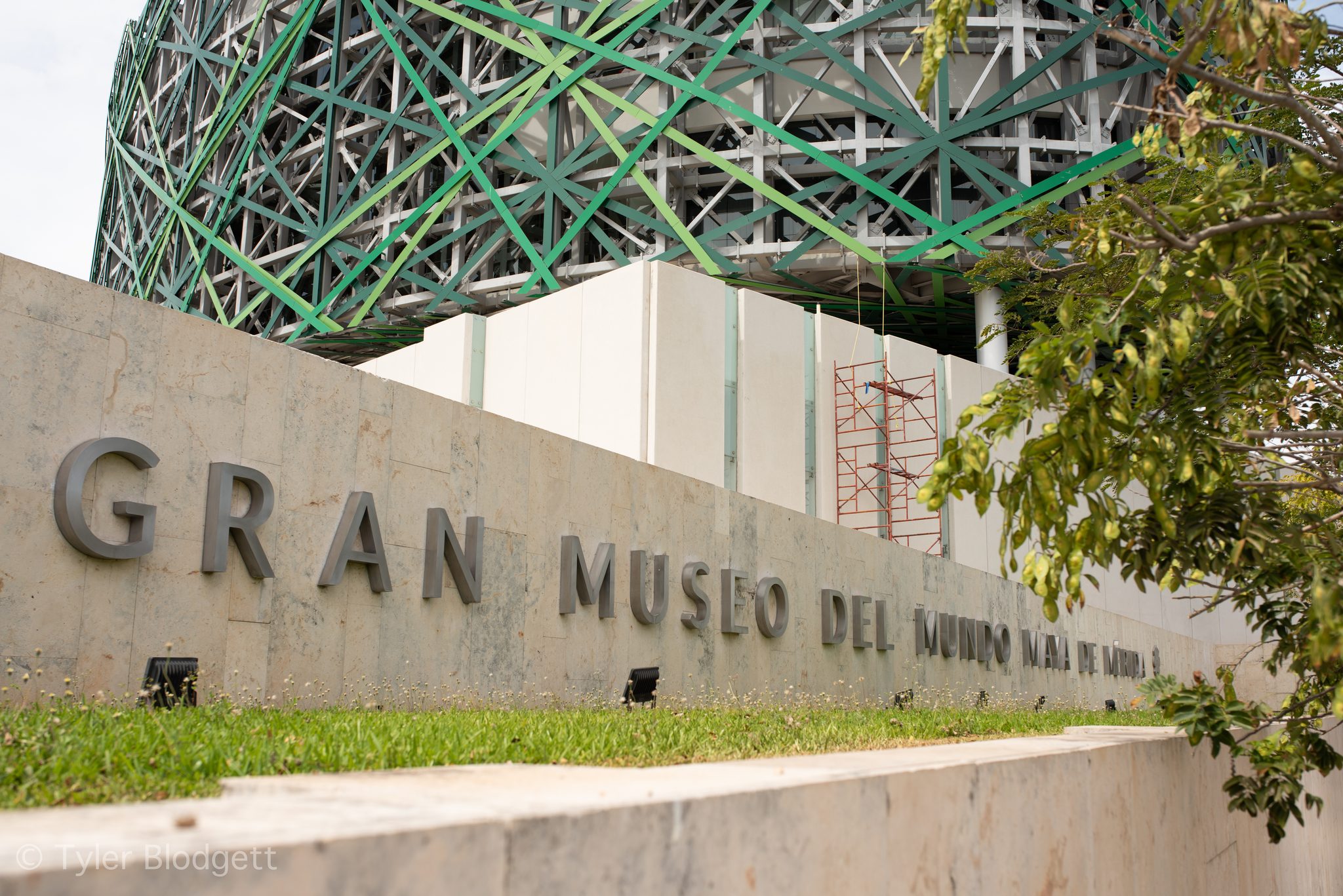
The museum's sign stands in the sun beneath its woven green canopy.Don Edgar speaks, hands folded at his chest. After his fervent oration came music, singing and chicha, a fermented corn drink shared as a toast to kith and kin.
In Don Edgar's garden in Acanceh, a man unfurls a banner painted with the Maya calendar among the trees.A painted clay vessel rests among yellow blossoms and purple flowers.
Rodo, a Mayan priest, prepares the ceremonial circle, placing maize, beans and leaves by their cosmic directions.
A clay censer swings from a cord, trailing smoke.Two men in white hold the offerings as one reaches up into the branches.
A man raises one hand to the sky and sounds the conch shell.
Conch in hand, he lifts his arm toward the canopy.Conch shells bellow toward the four corners of the Earth as the ceremony opens.
Alicia, a Mayan priestess, blows the conch, head tipped back.
Alicia and a priest sound their conches at once in the red dusk of the garden.Alicia, a Mayan priestess, kneels in prayer, cradling a ceremonial conch: the number seven, the sacred spiral of creation.
In Acanceh, the yellow bell tower of the church rises beyond the old stones of the pyramid.
Straight down from the sky, rooftops and courtyards line a quiet street in Acanceh.From above, the stepped pyramid of Acanceh sits in the middle of town, the yellow church just beyond.
In Ek Balam, a man pushes a wheelbarrow of seedlings for Sembrando Vida past a dog napping in the shade.
A young man climbs a ladder to rig the shade frame over the nursery.Under the shade frame, the crew fills black bags with soil for seedlings. Through Sembrando Vida (Sowing Life), a federal program, Mayan villagers are paid to plant trees and keep milpas.
Another load of potted seedlings rolls through in a green wheelbarrow.
Deep in the woodland of Ek Balam, the shaman walks up to the forest altar, a censer in hand.He crouches to tend the fire before the ceremony begins.
He blows on the smoldering branch to wake the flame.
Flame catches beneath him as he blows on the branch.His hand rests on a slender trunk, the white of his clothes bright against the forest.
Smoke rises from the clay censer as he holds it out.
Framed by a stone doorway, the elder kneels at the altar while a child watches.Visitors raise their arms as the shaman leads a ceremonial blessing for a German family. Private rituals like this one are a large source of income for the village.
The elder grins from behind the wheel of a white pickup.
Crafts, feathers, drawings and a certificate crowd the wall of the Ek Balam schoolroom.Students in Ek Balam laugh around a table beneath a painted tree covered in photos.
In a tiny, sweltering schoolroom in Ek Balam, students bend over their notebooks under the painted tree. They go door to door, telling families about milpas and the harm of discarded plastic.
Students take notes beneath a thatched roof hung with bags and papers.A man rests his hand on a pale trunk and looks up into the forest.
Sophia stands among the raised beds she and her partner Paul grow in the Yucatán's hard soil, fed by a nearby cenote.
Sophia tips her head back and laughs in the garden. She and Paul moved from North America to keep this land from the city's spread.Still laughing, she looks up past the palm trunk.
Sophia in the dry scrub as the light fades. Since she and Paul took on the land, endangered birds have returned, and they have found Mayan ruins buried in the hills.
Sophia works the dough in a wooden bowl on her kitchen counter.She lifts the dough high and lets it stretch.
A dirt road disappears into the dry forest at dusk.
An old chimney stands against a blazing sunset over the rooftops.A young tree stands knee high beside Don Simo's boots in his milpa.
Don Simo crouches to check a sapling in his milpa, a garden grown by ancient Mayan methods in the hard soils of the Yucatán.
Machete in hand, he clears the ground around the young trees.Young trees planted for Sembrando Vida stand in rows across the cleared field in Ek Balam.
A weathered hand holds out a plate of meat fresh from the fire.
Ears of corn hang to dry in the rafters of Don Simo's thatched roof.A woman stirs a pot over an open fire in the thatched kitchen.
Two hands scoop dried corn kernels from a bucket.
Fresh tortillas cook on the comal as she presses out another.Green light pours through a window onto the kitchen table.
Don Simo stands at the green-lit window of his home in Ek Balam, the village whose name means Black Jaguar.
Don Simo's home altar: the Virgin of Guadalupe, Christ and a blue cross among the flowers. "This was more than a home, it was sanctuary."Sunlight falls across a blue-patterned bowl on the wooden table.
Don Simo and Rony sit in the dirt road, soaking in the day's final rays as we send the drone to a nearby Mayan temple.
From above, the flat scrub forest runs all the way to the horizon.Sunbeams fall across the endless green and gray of the Yucatán forest.
Three men wave from the trunk of a car in the forest.
The sun sets over the forest canopy at Ek Balam, its Mayan temple hidden among the trees.Golden light spills across the forest and the ruins of Ek Balam, thrones buried for a thousand years.