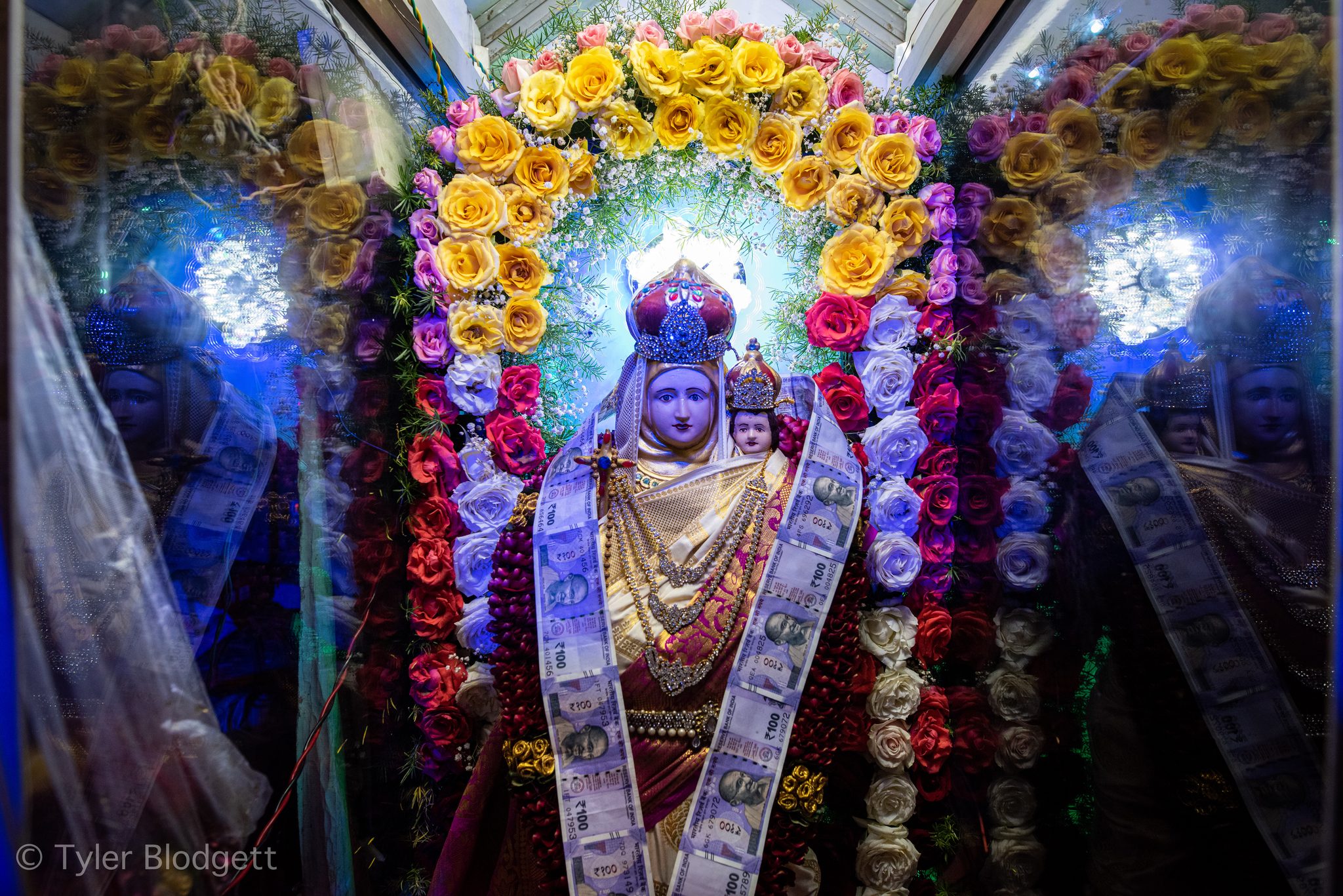
In 2019 Ankitha and I traveled thousands of kilometers along the Kaveri River and its sister tributaries, documenting what we saw and listening to the stories of those whose lives are entwined with these rapidly changing waters. At Mettur, toward Bengaluru, the river runs at its widest and feeds the fields. Further south the shoreline is scarred by decades of sand mining, and outside Thanjavur pump stations send its groundwater to the cities. Dammed, diverted, sucked dry, by the time the Kaveri reaches the Bay of Bengal it is only a trickle, and fishermen like Pichandi do not know when or if the water will rise again. Our rivers are the vascular system of our planet. What happens upstream compounds, little by little, into the most dire conditions downstream.
One boy hits the water as another climbs the rock for his turn.Floodlights blaze along the dam at night, the water black below.
Smokestacks rise from the mill as dawn breaks over the plain.He pauses in the field and meets the camera.
A man shoulders a huge bundle of greens beneath the rocky peak in the fields of Mettur.
A farmer points out across the field, an armful of grass under his arm.He looks back over his shoulder, the lake and the peak behind him.
He sits on a blue-painted wall, hands resting on his knees.
The elder walks hand in hand with a young woman along a rocky path.Hands reach up to ring the temple bells as the festival crowd presses in.
Banana groves and red earth roll down to the water at Mettur, where the Kaveri runs at its widest and waters the fields around it.
Colorful burial pyres on the edge of the Kaveri, the water and a power pylon beyond.Rubbish piles high behind a wall painted with Tamil lettering.
A stream runs thick with rubbish past the backs of houses.
A man washes beneath water spilling from the rocks, a pipe pouring into the pool below.A dog trots across a bamboo footbridge over the stream.
A girl in a flowered dress stands against a weathered wall.
A Ganesh Chaturthi procession comes down the dirt road, a boy in red leading the way.A boy with a face full of pink powder stands before the procession.
Garlanded in flowers, Ganesha waits beside the families who carried him, soon to be immersed in the river and returned to his celestial home on Mount Kailash.
Rushing through the village to catch the sunset, we were stopped by locals who insisted we meet this woman and her little green parakeets.A green-faced deity peeks out from behind a patterned tarp.
Pigs root through a mound of rubbish beneath the palms.
A narrow strip of green runs between two concrete walls.The river winds between green hills and patchwork fields.
The river sweeps past a quilt of green and red plots.
Straight down, a drain spills into the river beside a crumbling house.The river bends through green farmland beneath a stormy sky.
The town crowds the riverbank, the water curving away into the haze.
A family of brothers from the north bathe in the Kaveri and clear debris from the shallows, the power lines of the hydroelectric plant above them.A mill spreads along the riverbank, a bridge crossing just downstream.
In the final days of Ganesh Chaturthi, the crowd gathers at night as Ganesha rides past on a lit float, bound for the river.
A barrage spans the wide brown river, the farmland stretching away on both banks.The lights of the town and a smoking chimney reflect in the still river at night.
He glances up from the net, the coracle heaped with green mesh.
A man sits in his coracle as the evening settles over the town's edge.Plastic and rubbish settle into the shallows, an orange bag caught among the branches.
Two dragonflies cling to a twig above the dark water.
Rubbish spills down the bank to the water's edge.Seen from above, bands of foam and green water pattern the river's edge.
A town presses against the river, a circular pit on the far bank.
Rooftops and trees crowd together, seen straight down.The sun sets over a riverbed of sand and shallow pools, a lone figure wading.
An elder holds a cloth to his chest as the sun goes down behind him.
A dirt track climbs over the dry, burned ground.A woman spreads a long cloth to dry on the bank of the Kollidam, where almost all the water is dammed and redirected.
Tall grass bends in the wind over the dunes.
On the dry bed of the Kollidam, a heavily controlled branch of the Kaveri, a woman strides across the sand with a red bucket.Tracks crisscross a sandy stretch of the riverbed, seen from above.
The riverbed lies scarred and bare, the water pushed to one side.
The river braids through channels and pools, its shoreline scarred by decades of sand mining, much of it done illegally at night.Construction crews work the sand beside a long bridge over the river.
An old carved door studded with worn metal plates.
Two men in checked lungis stand on the red dirt road, one leaning on a staff.A long bridge stretches across the horizon beyond the scrub.
A Tamil Nadu water board pumping station outside Thanjavur. Stations like this pipe groundwater to nearby cities, and more are being built despite protests from local farmers.
He holds still for the camera, eyes steady.A little girl clutches her teddy bear beside a parked motorbike.
The sun sets over the paddy as a cow grazes alone.
A long bridge crosses a riverbed that is mostly sand, the water a narrow channel below.Pichandi walks toward the Bay of Bengal between the breakwaters at the river's mouth.
A drowned statue of Lord Ganesha lies exposed on the sand at the river's mouth, bamboo and marigolds strewn around it, disrupted in its rebirth.
Pichandi, a lifelong fisherman, on the beach where the Kaveri meets the Bay of Bengal. By the time the river arrives here it is only a trickle.A yellow and white boat leans on the sand beside the rocks.
Waves wash against a jetty of dark boulders under a white sky.
Water pours through the gates of a small dam.The net flies open over the water as he casts.
Brown floodwater surges past the railing.
From above, two breakwaters guide the river into the sea.The river cuts through a coast of ponds and paddies to reach the sea.
Invited to a local Kumbh outside Thanjavur, villagers young and old take turns pounding spices into a paste to be offered.A sandy bank pocked with pits borders the river, seen straight down.